
Lease Tracking Software: Why Spreadsheets Fall Short
Ask a CAM to pull up the lease information for a specific unit and watch what happens. The good ones open a spreadsheet. The great ones open a spreadsheet, a shared drive, and their email inbox, and then start cross referencing all three. That is not a criticism of the manager. It is a description of what happens when lease tracking depends on tools that were never designed for it.
Leases carry dates that matter. Rent increases have notice windows. Renewals have expiration windows. Condo boards have approval windows for new leases. Community documents require specific handoffs when a lease ends. None of that lives naturally inside a spreadsheet. It lives in someone's memory, in a folder no one else knows about, or in an email chain from six months ago that no one has thought to search.
That is the real problem with using spreadsheets for lease tracking. Not that they cannot hold information, but that they cannot manage the process that information belongs to.
What is lease tracking software?
Lease tracking software is a tool that manages active leases inside a community, including start and end dates, renewal windows, notice periods, resident information, and the underlying lease documents themselves. Purpose built lease tracking software is different from a general spreadsheet or shared drive because it treats the lease as a live record, not a stored file. It surfaces dates before they matter, keeps documents attached to the correct unit and resident, and gives managers and boards the same view of what is happening across a portfolio.
Why the spreadsheet approach breaks
Spreadsheets are the default because they are free, familiar, and low commitment. For a small community with three or four active leases, that may be enough. The problem is that most community associations do not stay at three or four active leases for long. Once a management company is overseeing several properties, or a single community reaches a few dozen active tenancies, the spreadsheet stops being a tracking tool and starts being a liability.
A few of the ways it breaks in practice:
Each of these is small on its own. Combined across a portfolio of associations, they add up to a slow, expensive process that quietly loses fidelity every month.
Where the operational risk actually hides
The bigger issue is not the time cost. It is what a manual lease tracking process can miss.
Consider a Florida condominium where a lease is set to expire on the last day of the month. The unit owner intends to lease to the same tenant again, but only if the board approves the renewal, since the community's governing documents require board approval for every new or renewed lease. The manager notices the expiration three days after it happened. Now the tenant is technically holding over, the board has not voted, and the association has to decide whether to backdate an approval, treat it as a new application, or ask the tenant to leave. None of those are good outcomes, and all of them were avoidable with better visibility on the expiration date.
Now scale that scenario across a management company with 40 associations. In any given month there will be dozens of expirations, renewals, notice deadlines, and board reviews in motion. A spreadsheet that shows all of them equally, with no logic about which one needs attention today, is a spreadsheet that will miss some of them.
There is a compliance dimension too. Florida Statutes Chapter 718 gives condominium associations specific authority around approval and disapproval of leases when the governing documents provide for it, along with rules about screening, security deposits, and application fees. The associations that get themselves into trouble are rarely the ones with bad intentions. They are the ones whose records cannot show, cleanly and quickly, that a specific process was followed for a specific unit. When lease records live in three different tools, that proof gets harder to produce.
Why lease tracking belongs inside resident onboarding
Here is the piece most tools miss. The lease is not a standalone document. It is the outcome of a process that started with an application, moved through screening, went through board approval, and produced a resident. When lease tracking sits in a separate tool from the rest of that process, information has to be manually copied across at every stage. That manual copying is where errors and gaps enter.
A connected approach works differently. The applicant's identity, income, screening results, and board approval are already recorded when the lease begins. The lease start date, the resident's contact information, the unit assignment, and the associated documents all flow into the lease tracking view without a manual handoff. When the lease approaches renewal, the same file is still there, with the same connected history, and the association can decide whether to renew, require a new application, or take another path with the full context available. This is what a proper resident onboarding platform makes possible.
This is the difference between lease tracking as a filing cabinet and lease tracking as part of a workflow. Both hold information. Only one of them saves time and reduces risk on an ongoing basis.
What CAMs and boards actually need
A workable lease tracking process has to solve for four operational realities.
Visibility across the portfolio. A CAM managing multiple associations should be able to open one view and see every lease expiring in the next 30, 60, or 90 days across every property. Not one association at a time. All of them.
Documents attached to the unit and the resident. Not stored somewhere else and referenced by a file name. The lease itself, along with any board approval, addendum, or notice, should live with the record it belongs to.
Renewal and notice logic that runs on its own. The system should know that a lease is coming up on renewal and prompt the right people at the right time, without depending on someone to remember to check.
A clear connection to the community's approval process. When a lease requires board review, that review should happen inside the same platform the lease lives in, not in a separate email thread or approval tool.
None of this is complicated in principle. It is difficult only when the tool doing the tracking was never built for lease tracking in the first place.
How TenantEvaluation helps
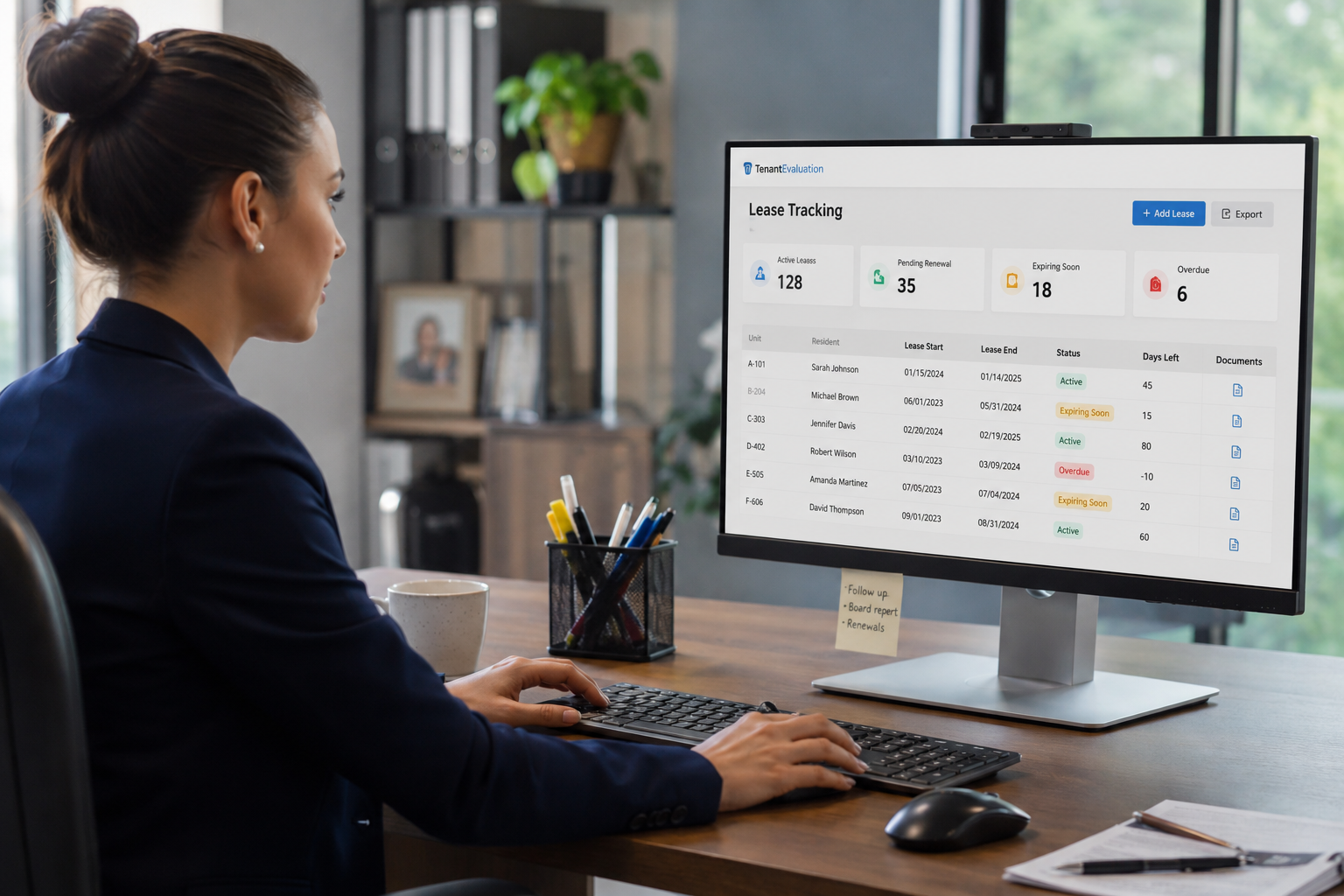
TenantEvaluation's Lease Tracking is built directly into the same platform that handles applications, screening, and board approvals for community associations. That matters because it means the lease record starts populated. There is no separate data entry step, no manual copying from an application to a lease tracker, and no reconciliation between two systems.
Once an applicant is approved through the board using QuickApprove, the lease information moves into Lease Tracking with the applicant's identity confirmed through IDverify, income documented through proof of income reports, and screening completed through SafeCheck already attached to the file. The lease itself, the board's approval, and any related documents live in one place, tied to the correct unit through the platform's Units management. Fees paid during the application flow are also part of the record, which matters when a security deposit needs to be tracked separately or returned later.
For a CAM managing several communities, this changes the daily rhythm. Instead of maintaining a spreadsheet per association, the manager opens one view of every active lease across the portfolio, sorted by whatever is most urgent today. Instead of a board member emailing to ask about the status of a specific unit, the board sees it directly. Instead of a renewal date being noticed three days late, it surfaces two months early with the right context attached.
That is what it means to build lease tracking into your workflow rather than beside it.
What to look for before switching away from spreadsheets
If your association is evaluating a change, these are the questions worth asking:
If most of the answers are "we still do that by hand," the tool has not solved the underlying problem. It has just moved the spreadsheet to a different screen.
Turning lease tracking into a controlled process
The associations that manage leases well are not doing anything dramatic. They have simply stopped treating lease tracking as an afterthought that lives outside the onboarding process, and started treating it as a continuation of it. When every lease is connected to the application and screening record that produced it, when every date is surfaced by the system rather than remembered by a person, and when every document is attached to the correct unit and resident, the process becomes something a board can actually see and a manager can actually control.
For a CAM or property management company running several communities, that control saves real time on every renewal, reduces the risk of missed notice periods, and gives boards the visibility they should have had from the start. It also protects the institutional memory of the association, so that a staff transition does not take the process with it.
The Consumer Financial Protection Bureau's Tenant Background Checks Market Report highlights how accurate, well documented tenant and lease information matters for consistent, defensible housing decisions, which is exactly what a connected lease tracking process is designed to support.
Frequently asked questions
What is lease tracking software and why is it different from a spreadsheet?
Lease tracking software manages active leases as live records, not stored files. It surfaces upcoming dates before they matter, keeps documents attached to the correct unit and resident, connects to the application and screening record that produced the lease, and gives managers and boards the same view across the portfolio. A spreadsheet can store the same information, but it cannot manage the workflow that information belongs to.
Can HOAs and condos use the same lease tracking software?
Yes, and they should look for a tool built with community associations in mind rather than one built for a single landlord. HOAs and condos have specific approval, notice, and documentation requirements that differ from a landlord managing one rental unit. Software built for community associations reflects those requirements.
Does connected lease tracking replace the board's role in lease approval?
No. Connected lease tracking gives the board better information and a clearer record. The board still reviews, votes, and approves or denies leases according to the community's governing documents. Requirements vary by association and by state, and boards should confirm their specific obligations with association counsel.
How does lease tracking connect to resident screening?
When lease tracking lives inside the same platform as resident screening, the lease record starts populated with the applicant's confirmed identity, screening results, income documentation, and board approval. There is no separate data entry step and no reconciliation between two systems. When a lease approaches renewal, the same file is still there, with the same connected history.
What happens to our existing spreadsheets when we switch?
Most associations continue to use their existing spreadsheets for reference on historical leases and route all new and renewing leases through the platform going forward. There is no need to migrate every past record to start benefiting from a connected process.
How does this help during staff transitions?
Because the process lives inside the platform rather than in one person's private spreadsheet or reminder system, a new team member can pick up the work without needing to be walked through someone else's tabs, naming conventions, and calendar reminders. The system carries the institutional knowledge that used to depend on a single employee remembering how everything was organized.
See how connected lease tracking removes the spreadsheet dependency for your community. Schedule a demo to see how it fits your workflow from application to renewal.
