
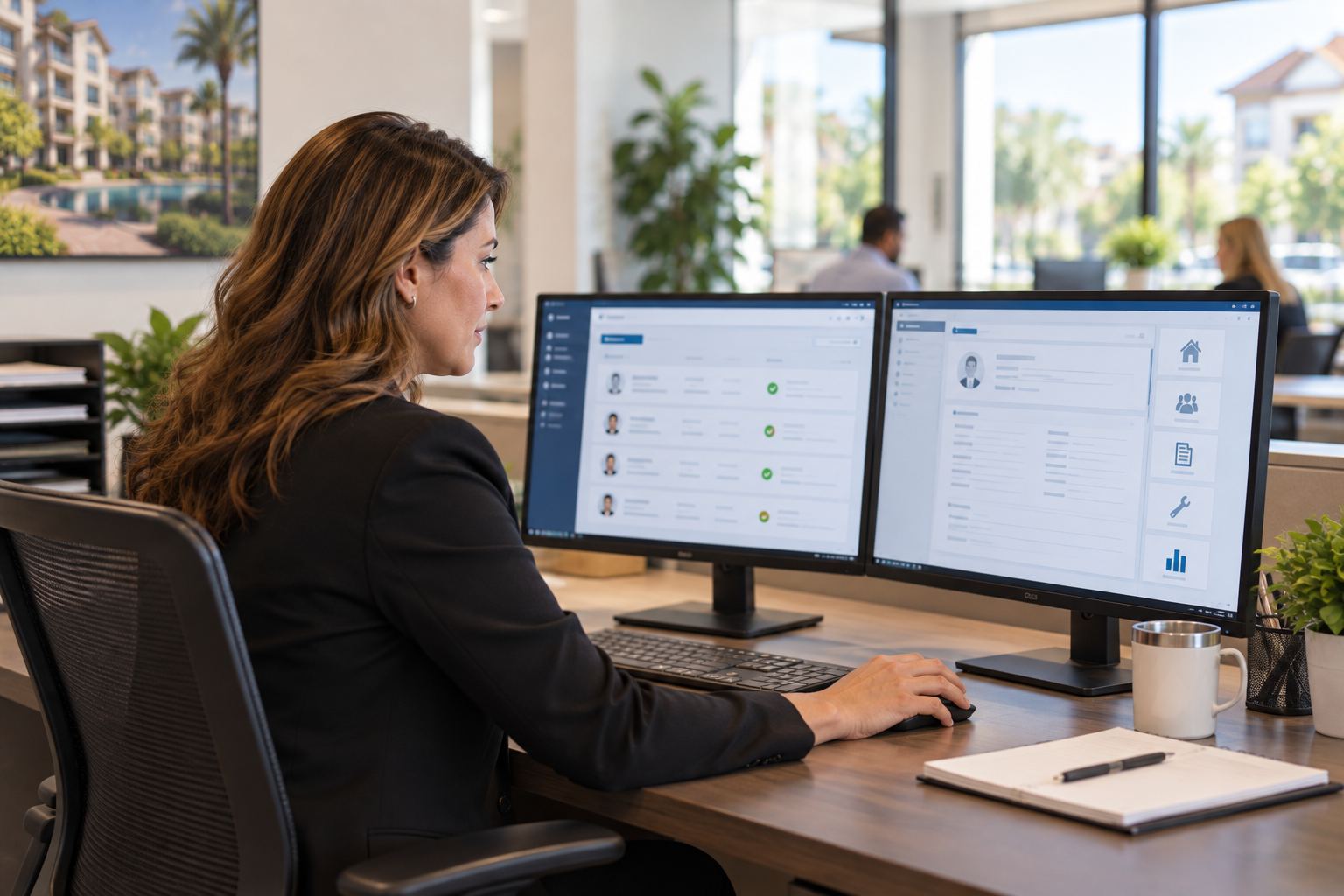
How Vantaca and Vertilink Fit Into Resident Onboarding
Most management companies evaluating resident onboarding software are not starting from a blank slate. They are already running an association management platform, often something like Vantaca or Vertilink, that handles accounting, owner communication, work orders, and the broader operational side of running a portfolio of communities.
That reality shapes a reasonable, common question: does adopting resident onboarding software mean replacing that system, or does it mean adding another disconnected tool to an already full technology stack. Neither answer is quite right on its own. The more useful way to think about it is where resident onboarding fits alongside a platform like Vantaca or Vertilink, rather than in place of it.
Why This Question Comes Up So Often
Association management platforms like Vantaca and Vertilink are built around the operational backbone of running a management company: general ledger accounting, owner and board communication, maintenance and work order tracking, and portfolio wide reporting. They are strong at that job because that is what they were built to do.
Resident screening, identity verification, board application review, and the fee and deposit collection tied specifically to a new resident's application are a narrower, more specialized workflow. Some association management platforms offer basic versions of these features. Others focus entirely on the back office side and expect a separate tool to handle onboarding.
Why Duplicate Data Entry Happens
When resident onboarding and association management run in separate systems with no connection between them, the same information tends to get entered more than once. A new resident's name, unit, and lease details get recorded during onboarding, then entered again into the association management platform once the resident is approved, since that system also needs current occupancy and owner information to function.
This is not a hypothetical inefficiency. It is a predictable outcome of running two systems that do not share data automatically. Someone, usually a CAM or an administrative team member, becomes the manual bridge between the two, re-entering the same resident details a second time and hoping nothing gets missed or mistyped along the way.
What Duplicate Entry Actually Costs
The cost shows up less as one obvious problem and more as a steady accumulation of small ones. A resident's move in date recorded correctly in one system and slightly wrong in the other. A unit status that says "occupied" in one place and "vacant" in another, until someone notices the mismatch. Staff time spent on data entry that adds no new information, just repeats what already exists somewhere else.
What Connecting the Two Systems Is Meant to Solve
The general goal of connecting resident onboarding software to an association management platform like Vantaca or Vertilink is straightforward: reduce how much information has to be manually carried from one system into the other once a resident is approved.
Exactly how that connection works, what specific fields transfer, how frequently, and through what technical method, depends on the specific integration in place at any given time, and management companies evaluating this should confirm the current details directly with their resident onboarding provider rather than assuming a specific technical capability.
Reducing Switching Friction, Not Forcing a Replacement
A common concern among management companies evaluating resident onboarding software is the fear of a disruptive migration, ripping out a system the accounting and operations teams already know well in favor of something new that would require retraining an entire staff.
Application approval and identity verification are examples of the more specialized workflow a dedicated onboarding platform is built around, while the association's broader financial and operational records stay where a management company already trusts them to be.
Unit Information and Operational Handoffs
An association management platform needs to know who currently occupies a unit for billing, communication, and reporting purposes. Resident onboarding software generates exactly that information as part of the approval process. Unit records that originate from the onboarding process, rather than being rebuilt separately after the fact, are a meaningful part of what makes this handoff smoother.
A Realistic Scenario
Consider a management company running Vantaca across a portfolio of twenty associations, with a separate resident onboarding process handled largely by email and a standalone screening tool. Each time an application is approved, someone on the team manually re-enters the new resident's name, unit, and move in date into Vantaca. Across twenty associations with a steady stream of new applications, that manual re-entry step happens dozens of times a month, each one a small task, none of them individually significant, but collectively a real and recurring draw on staff time.
What to Ask When Evaluating Integration Options
- What specific information moves between the two systems? Confirms exactly what is and is not automatically shared.
- How is the connection established and maintained? Clarifies whether it is a one time setup or an ongoing sync.
- What happens if the connection needs troubleshooting? Sets expectations for support if something breaks.
Thinking About Data Ownership and Long Term Fit
One more practical consideration worth raising directly with any resident onboarding provider is data ownership and portability: where the authoritative record of a resident's information lives, how that information can be exported if needed, and what happens to historical application and screening records if the company ever changes either system down the line.
Frequently Asked Questions
Do I need to replace Vantaca or Vertilink to use resident onboarding software?
Generally no. Resident onboarding software is typically built to handle the screening, identity verification, and board approval workflow specifically, while an association management platform continues to handle accounting, communication, and broader operations. The two are meant to work alongside each other.
What does an integration between resident onboarding software and an association management platform actually do?
At a conceptual level, the goal is reducing duplicate data entry, so information from an approved application does not need to be manually re-entered into the association management system. The specific technical details of any integration should be confirmed directly with the provider, since capabilities vary.
5Why does duplicate data entry happen between onboarding and association management systems?
It happens when the two systems do not share information automatically, requiring someone to manually enter the same resident or unit details into each system separately. This is a common outcome of running specialized tools that were not built to communicate with each other.
If your team is already running Vantaca, Vertilink, or a similar association management platform and manually re-entering resident information after every approval, talk to TenantEvaluation about how resident onboarding fits alongside your current systems. Schedule a demo to ask about your specific setup.
