
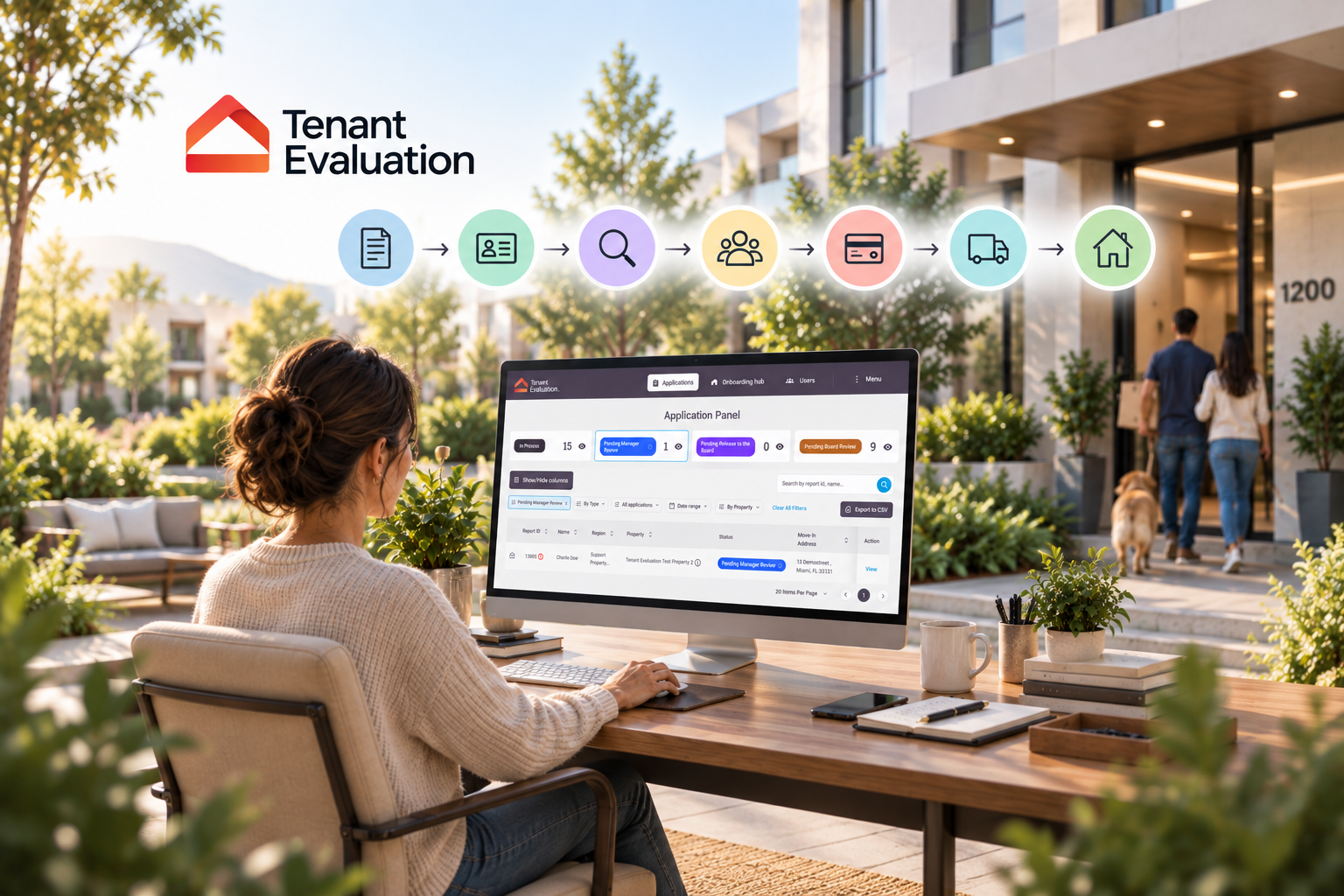
How Resident Onboarding Works From Application to Move In
Ask a CAM what resident screening involves and most can explain it in a sentence: run a background check, confirm identity, review income, send the results to the board. Ask the same person to describe the full resident onboarding process, from the moment an applicant submits paperwork to the day they move in and beyond, and the answer usually gets longer and less certain.
That gap matters. Screening is one part of onboarding, not the whole thing. Between an application landing in someone's inbox and a resident settling into a unit, there are usually seven or eight separate steps, several of them handled in different systems by different people. When those steps are not connected, the work does not disappear. It just becomes harder to track.
This article walks through the resident onboarding process stage by stage, the way it actually happens inside most HOAs and condo associations, and points out where things typically slow down.
What Is the Resident Onboarding Process for HOAs and Condos?
- Application Intake Applicant submits the application and any required disclosures.
- Identity Verification The applicant's identity is confirmed against submitted documents.
- Screening Background check and supporting documentation are reviewed.
- Board Review and Approval A board or committee reviews the file and records a decision.
- Fees and Deposits Application fees and refundable deposits are collected and tracked.
- Move In Dates, communication, and move in requirements are coordinated.
- Lease and Unit Records The application becomes a lease and the unit record is updated.
The resident onboarding process is the full sequence of steps a community association follows to review, approve, and welcome a new resident, starting with the application and ending with that resident being fully reflected in the association's records.
Resident screening sits inside this process. It is not a substitute for it. An association can run a flawless background check and still have a slow, confusing onboarding experience if the steps before and after screening are disconnected.
Where the Process Actually Starts: Application Intake
Onboarding begins the moment someone submits an application, and this is where a surprising amount of friction gets built in early. Paper applications, PDF forms sent by email, and portals that do not talk to anything else all create the same problem: information arrives in a format that has to be manually re-entered somewhere before anyone can act on it.
For a CAM managing several associations, this adds up. A missing signature, an unclear field, or an incomplete document at intake usually means a phone call or an email chain before screening can even begin. None of that time shows up in a screening report, but all of it is part of the resident onboarding process, and it is often where the most delay accumulates.
A cleaner intake step, one that flags missing information immediately instead of after a manual review, removes a meaningful amount of that back and forth before the application ever reaches a background check.
Confirming Who Is Actually Applying
Before screening results mean anything, the association needs confidence that the person named on the application is the person who submitted it. This step often gets folded into "screening" in conversation, but it is really a separate check: matching a government issued ID against the applicant's stated identity and supporting documents.
Manual document review catches obvious mismatches but misses more than most people expect, especially with better quality fraudulent documents in circulation. Automated identity verification checks documents against known formats and security features and flags inconsistencies a reviewer might not catch on a screen. That confirmation becomes the foundation the rest of onboarding is built on. If the identity behind an application is uncertain, everything downstream, the background check, the income verification, the eventual lease, inherits that uncertainty.
Running the Background Check and Reviewing Supporting Documents
This is the stage most people picture when they hear "resident screening." A background check for community associations typically covers criminal history, eviction history, and financial background, alongside supporting documentation like proof of income or bank statements.
It is worth remembering that these background checks are consumer reports under federal law, and housing providers using them have specific obligations around how the reports are used and how applicants are notified when a decision is based on them. The FTC's guidance for landlords and housing providers and the CFPB's tenant background check resources both outline these responsibilities in plain language.
Where onboarding tends to slow down here is document collection. A criminal background check can return in minutes. Proof of income, pay stubs, employment letters, bank statements, often does not, especially when applicants are asked to email documents separately from the application itself. Every document sitting in an inbox instead of attached to the applicant's file is a document someone has to go find later, usually right before a board meeting.
Turning Screening Results Into an Actual Board Decision
Once screening and documentation are complete, someone has to actually make a decision, and for most HOAs and condos, that means a board or a screening committee. This is where a completed screening report meets a much less structured process: emailing a PDF around, waiting for replies, tallying informal votes, and trying to remember who approved what and when.
It is a reasonable process on paper. It is a difficult one to document consistently, and documentation matters here for reasons beyond internal organization. Boards are expected to apply screening criteria consistently across applicants, and HUD's guidance on screening applicants for rental housing under the Fair Housing Act points out that inconsistent or overly broad screening criteria, even when unintentional, can create fair housing exposure. A clear, repeatable application approval workflow gives boards a defensible record without requiring anyone to change how they actually make decisions. This is not legal advice, and boards should still involve counsel when questions come up, but consistent documentation is a reasonable operational habit on its own merits.
Collecting Fees and Deposits Without Losing Track of Who Paid What
Somewhere in the middle of the approval process, money usually changes hands: an application fee, a security deposit, sometimes a move in fee set by the association's governing documents. Handled manually, this becomes its own small accounting project.
Multiply that across a portfolio of associations and dozens of applications a month, and payment tracking becomes a real source of administrative time, not because any single payment is complicated, but because reconciling payments across disconnected records rarely is quick. Built in payment collection that ties each payment directly to the applicant's file removes the manual matching step and gives boards a clear answer, without a spreadsheet, to a simple question: has this applicant paid what they owe.
What Happens Between Approval and Move In
Approval is not the end of onboarding, even though it often gets treated that way. Between a board's decision and an applicant's first day in the unit, there is usually a short list of remaining items: confirming a move in date, coordinating with the current owner or property manager, communicating any move in rules the community has, and making sure the resident has the information they need before they arrive.
None of this is complicated, but it is easy to lose track of if the file that contained the application, the screening results, and the approval record is not the same file that carries forward into move in coordination.
Where Onboarding Continues After Move In
Resident onboarding does not end when someone gets their keys. Once a resident moves in, that application becomes a lease, and the unit's occupancy record needs to reflect who actually lives there.
Lease tracking that starts from the original application, rather than being re-entered separately once someone moves in, keeps renewal dates, lease terms, and documents attached to a resident's history instead of scattered across a separate spreadsheet built after the fact. The same is true for unit records: accurate, current occupancy information at the unit level makes every future onboarding cycle for that unit, and every board report that references it, faster and more reliable.
Why the Process Breaks Down When Each Stage Lives in a Different System
None of the individual steps described above are unusual or difficult on their own. The difficulty shows up at the seams, when an application submitted in one system has to be manually carried into a screening tool, then again into an email thread for board review, then again into a spreadsheet for payment tracking, then again into whatever system tracks leases and units.
Each handoff is a small chance for something to get missed. Individually, these are minor. Across a portfolio of associations and a steady stream of applications, they become a real source of rework, and a real reason CAMs end up spending time on administrative follow up instead of the parts of the job that actually require their judgment.
See how TenantEvaluation connects application intake, screening, approvals, and resident records into one process instead of five separate ones.
What a Connected Resident Onboarding Process Looks Like
A connected resident onboarding process does not eliminate any of the stages described above. What changes is that the same applicant file carries through every stage, instead of being rebuilt at each handoff.
That means a CAM can open one record and see the application, the screening results, the approval history, and the payment status without checking four different tools. And it means the lease and unit records that matter six months or a year later already exist, because they were created from the original application instead of recreated after the fact.
Questions Boards and CAMs Should Ask When Evaluating an Onboarding Process
Does the same applicant record follow the application from intake through screening, approval, and move in, or does someone re-enter information at each stage. Can a board member see application status without asking the CAM directly. Is there a record of who approved an application and when, separate from anyone's memory of the meeting. Does the payment status for fees and deposits live next to the applicant's file, or in a separate spreadsheet. And once a resident moves in, does the lease and unit record get created automatically, or does that become a second project.
If the honest answer to most of these is "it depends who you ask," that is usually a sign the onboarding process is running across more separate tools than it needs to.
Frequently Asked Questions
What is the resident onboarding process for a community association?
It is the full sequence of steps involved in reviewing, approving, and welcoming a new resident, including application intake, identity verification, background screening, document review, board approval, fees and deposits, move in coordination, and the lease and unit records created afterward. Screening is one stage inside this larger process.
Is resident screening the same thing as resident onboarding?
No. Screening, background checks, identity verification, and income review, is one part of onboarding. The full process also includes application intake, board approval, fees and deposits, move in coordination, and the lease and unit records that follow once a resident is in place.
Can resident onboarding software replace a background check company?
Resident onboarding software typically works alongside background screening rather than replacing it. The value is in connecting the screening results to the rest of the process, application intake, board approval, fees, and lease records, so the information does not have to be manually carried between separate systems.
If your team is still re-entering the same applicant information across separate tools for screening, approvals, payments, and lease records, that is exactly the gap a connected resident onboarding process is built to close. Schedule a demo to see how TenantEvaluation carries an applicant's file from intake through move in without the handoffs.
