
How Structured Lease Tracking Helps CAMs Work Smarter, Not Harder
The best CAMs are not the ones who work the most hours. They are the ones who have built workflows that keep them ahead of the work rather than constantly catching up to it.
Lease management is one of the clearest areas where a smarter workflow makes a direct difference. When lease expirations are tracked automatically, renewals are documented from the start, and boards have real-time visibility into community status, the management team operates with confidence instead of scrambling to fill gaps.
This article breaks down what structured lease tracking looks like in practice, why it matters for CAMs and community associations, and how the right platform turns a traditionally manual process into one of the smoothest parts of your workflow.
The Problem Most Management Teams Do Not See Clearly
The challenge with poor lease management is that the costs are distributed. No single missed expiration feels catastrophic. One manual report does not take that long. One extra email to track down a signed document is just part of the job.
But multiply those friction points across a portfolio of 200 units, 12 properties, and 4 CAMs, and the picture changes. What looked like minor inefficiency becomes a significant operational burden that absorbs staff time, increases compliance risk, and undermines board trust.
The three primary cost drivers are time, documentation risk, and visibility gaps. Each one has real consequences for community associations.
Benefit 1: Structured Lease Tracking Gives CAMs Their Time Back
Manual lease administration is labor-intensive. It requires someone to maintain records, follow up on renewals, generate reports, and communicate with residents and boards. In most management offices, these tasks fall to CAMs who are already managing multiple other priorities.
Consider what a typical manual lease management cycle looks like:
A CAM reviews a spreadsheet every few weeks to identify upcoming expirations. When they find one, they send a manual notification to the resident. If the resident does not respond, they follow up again. If a renewal is agreed, the CAM prepares or requests the new lease, collects signatures, and updates the spreadsheet. If the board needs to approve the renewal, the CAM prepares documentation and brings it to the next meeting.
Each step requires human attention. Each step introduces the possibility of delay, error, or omission. And each step is largely reactive rather than proactive.
The Florida Department of Business and Professional Regulation (DBPR) licenses and regulates Community Association Managers across the state. As of July 2025, licensed CAMs are required to maintain updated records of every community they serve and report changes within 30 days. That means the documentation burden on management teams is not just an internal preference. It is a regulatory expectation.
When those tasks are structured around manual spreadsheet management rather than automated workflows, the time cost is significantly higher than it needs to be.
What this means for your management company: Every hour a CAM spends on manual lease administration is an hour not spent on higher-value work. At scale, that time cost translates directly into reduced capacity and higher operational overhead.
Benefit 2: Better Documentation Means Stronger Protection for the Association
Florida community associations operate under specific requirements around lease documentation, board approvals, and record-keeping. When lease records are maintained manually, the documentation gaps tend to accumulate quietly until they become a problem.
Under Florida Statute 720.303, HOAs are required to maintain official records for a minimum of seven years. This includes records related to the lease, sale, or transfer of a parcel. Condominium associations fall under Florida Statute 718.111(12), which similarly mandates organized, accessible record maintenance. These are not suggestions. They are statutory obligations that apply to every licensed community association in Florida.
The Community Associations Institute (CAI), the leading national authority on community association governance, also identifies records management and organized documentation as a foundational best practice for HOAs and condo boards operating at a professional standard.
Common documentation failures in manual lease management include:
Missing signed lease copies. The executed lease was never saved in a central location, or the version on file is unsigned or incomplete.
No record of board approval. The board approved the lease verbally or via email, but there is no formal documentation of the decision linked to the lease record.
Incomplete renewal documentation. A lease was renewed informally without generating a new signed agreement, creating uncertainty about the current terms.
No audit trail for lease changes. An addendum was added to a lease but there is no record of when it was executed or who approved it.
Expired leases in holdover status without documentation. A lease expired and the resident continued occupying the unit, but there is no written holdover agreement and no formal documentation of the extended tenancy.
Each of these gaps creates risk. In a dispute, a review, or an audit, incomplete documentation puts the management company and the association in a difficult position.
Proper lease tracking tools address this by requiring structured documentation at each stage of the lease lifecycle. When the system requires a signed document before a record can be marked complete, gaps are identified and filled before they become problems.
Benefit 3: Real-Time Visibility Helps Boards Make Faster, Smarter Decisions
Boards rely on accurate information to make good decisions. When lease data is scattered across spreadsheets, email threads, and individual CAM notes, the board's access to that information is filtered through manual reports that may be incomplete or out of date.
This creates a predictable set of problems:
Boards ask for reports that take time to prepare. A board member asks how many leases are expiring in Q4. The CAM spends an hour compiling the answer from multiple sources. The board receives information that is already slightly outdated.
Decisions get delayed. A renewal requires board approval, but the meeting packet did not include the lease documentation. The approval is pushed to the next meeting, extending the resident's uncertainty and the management team's workload.
Boards lose confidence in management reporting. When reports are inconsistent or require significant back-and-forth to produce, boards begin to question the accuracy of the data they are receiving. That erosion of trust is difficult to rebuild.
It is worth noting that starting January 1, 2026, Florida updated its digital transparency requirements. Under Florida Statute 720.303(4), HOAs with 100 or more parcels must now operate an official website or secure member portal providing access to required records and documents. For condominiums with 25 or more units, Florida Statute 718.111(12)(g) sets the same requirement. These updates signal a clear direction: associations are expected to provide organized, digital access to community records.
A structured lease management platform gives boards real-time read access to lease status across their community. Expiration reports are generated automatically. Renewal decisions are routed through documented approval workflows. The board has what it needs without requiring the CAM to build a manual report on demand.
What Structured Lease Tracking Delivers: A Practical Comparison
Here is what the difference looks like in practice across the five areas that matter most to CAMs and management teams.
Staff time per renewal drops from 2 to 4 hours per cycle down to under 30 minutes when alerts and workflows are automated. Missed expiration rates, which run between 5 and 15 percent in manual systems, fall to near zero when the platform flags upcoming dates automatically. Documentation completeness shifts from variable and gap-dependent to structured and required by the workflow itself. Board reporting time goes from 1 to 3 hours per cycle to real-time and automated. And compliance documentation risk, which is high without audit trails, is significantly reduced when every action on a lease record is logged automatically.
The difference is consistent across portfolios of all sizes. Structured lease tracking saves time, improves documentation quality, and gives the right people better information without manual effort to produce it.
Proactive Renewal Tracking: How Staying Ahead Changes Everything
One of the most predictable and preventable costs of poor lease management is the cascading delay that happens when lease renewals are not tracked proactively.
When a CAM identifies a lease expiration 90 days in advance, the renewal process is structured, low-pressure, and fully documented before urgency sets in. There is time to communicate clearly with the resident, prepare the paperwork, route for board approval if needed, and close the renewal cleanly.
Month-to-month situations introduce a different set of management challenges. The lease is no longer tied to a defined term. The resident's status is ambiguous. The documentation is lighter than a full renewal. And the management team now has an open item that requires ongoing attention until a new lease is executed.
This compounding problem starts with a single missed expiration date. A lease renewal tracking system prevents it from happening in the first place by surfacing expiring leases before the timeline becomes urgent.
How TenantEvaluation's Lease Tracking Feature Addresses These Costs
TenantEvaluation is building Lease Tracking as a native feature within the resident onboarding platform. This matters because it means lease data is not isolated. It lives alongside application records, background check results, identity verification data, board approvals, and resident documentation in the same environment.
For CAMs, this means:
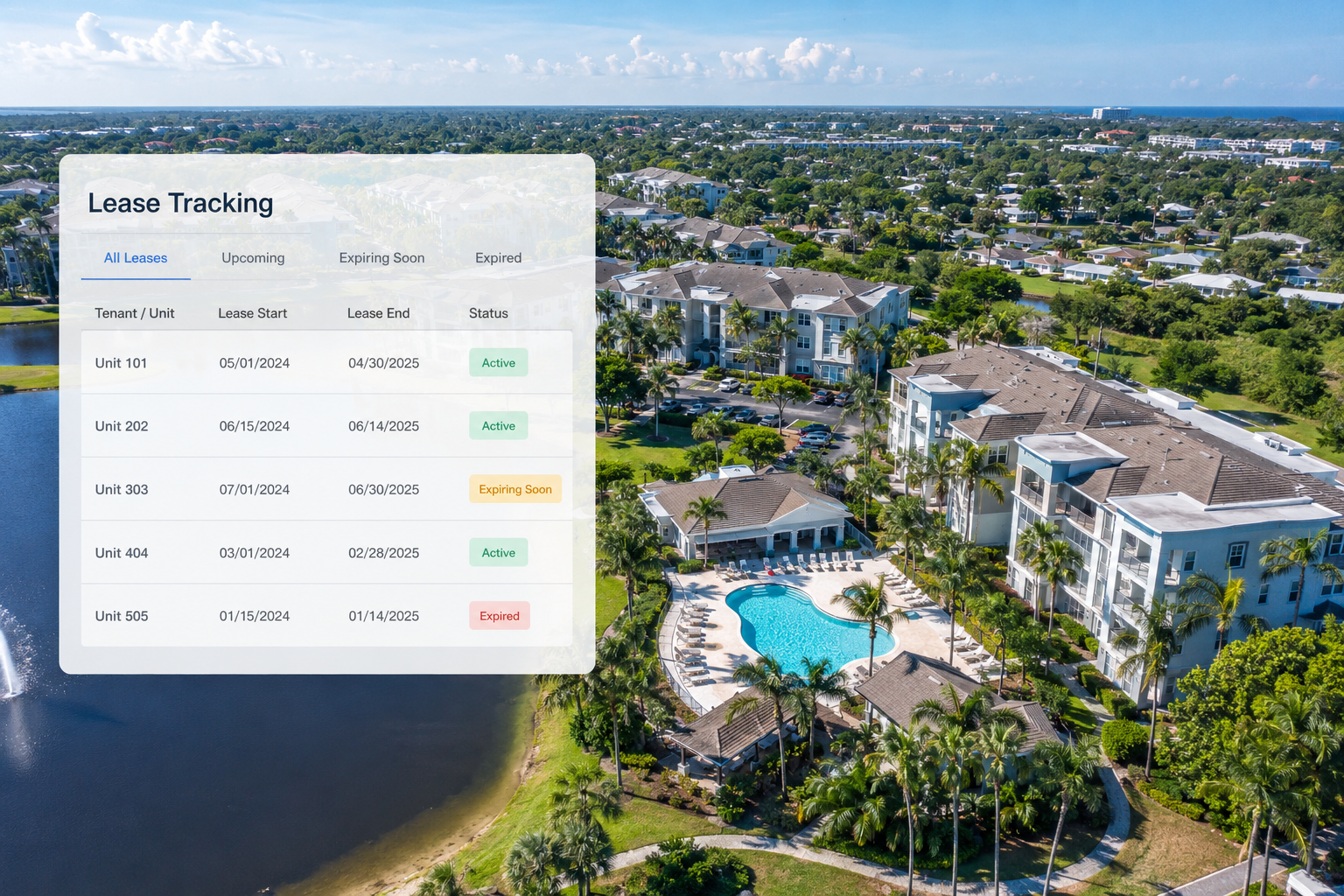
Lease expirations are visible from the dashboard without running a manual report.
Automated alerts surface upcoming expirations at configurable intervals, giving the team enough runway to act before urgency sets in.
Renewal workflows are structured and documented, creating an audit trail that supports board decisions and protects the management company.
Boards can access lease status within their community without requesting a report, improving transparency without adding to the CAM's workload.
Documentation is linked directly to the lease record, ensuring that every agreement, addendum, and approval is stored in one place and accessible when needed.
The result is a significant reduction in the hidden costs that accumulate when lease management runs through manual systems.
What to Look for in Lease Management Software for HOAs
If your management team is evaluating property lease management software, these are the capabilities that matter most for community associations:
Automated expiration alerts. The system should surface upcoming expirations automatically at 90, 60, and 30 days, without requiring someone to check manually.
Centralized document storage. Every signed lease, addendum, renewal, and associated document should live in one place, linked to the correct unit and resident record.
Structured renewal workflows. Renewals should follow a defined process that includes documentation, board routing when required, and confirmation at each step.
Audit trails. Every change, decision, and action taken on a lease record should be logged with timestamps and user attribution.
Board visibility. Boards should be able to view lease status across their community without requiring the CAM to generate manual reports.
Integration with onboarding and background checks. The most efficient setup is one where lease tracking connects directly to the background check and screening process, so records are created once and carry through the full lifecycle.
Structured lease tracking is one of the highest-return improvements a CAM team can make to its workflow. It saves time, improves documentation quality, keeps boards informed, and removes the reactive urgency that makes lease renewals harder than they need to be.
Florida law sets clear record-keeping expectations for HOAs and condo associations. The DBPR holds licensed CAMs to professional documentation standards. And industry organizations like the Community Associations Institute consistently identify organized records and documented governance as foundational to well-run communities. The right technology makes meeting all of those expectations straightforward rather than burdensome.
A structured lease tracking system automates what should be automated, organizes what should be organized, and gives the right people the right visibility without manual effort to produce it.
TenantEvaluation's Lease Tracking feature is built to deliver exactly that for CAMs, HOAs, and property management companies, by connecting lease lifecycle management directly to the platform where background checks, resident approvals, and onboarding already happen.
See how Lease Tracking fits into your workflow. Learn more at TenantEvaluation.
Frequently Asked Questions About Lease Management for HOAs
What is lease management software?
Lease management software is a tool that centralizes lease records, automates expiration alerts, manages renewal workflows, and provides organized documentation for property managers and community associations. It replaces manual spreadsheet tracking with structured, automated processes.
What are the best practices for HOA lease management?
Best practices include centralizing all lease records in one system, setting automated alerts for expirations at 90, 60, and 30 days, documenting every stage of the renewal process, giving boards structured read access to lease data, and maintaining complete audit trails for all lease actions.
What does Florida law require for HOA lease records?
Florida Statute 720.303 requires HOAs to maintain official records, including lease-related documents, for a minimum of seven years. Condominium associations fall under Florida Statute 718.111(12), with similar requirements. Florida associations should consult qualified legal counsel for guidance on their specific obligations.
